Ecommerce Web Design Trends That Maximize Sales Conversions

Ecommerce Web Design Trends That Maximize Sales Conversions in 2026
Reading time: 9 minutes
Ever landed on a store, loved the products, but bounced before checkout anyway? You’re not alone. In 2026, the gap between “browsing” and “buying” has never been narrower—or more unforgiving. Shoppers expect speed, personalization, and frictionless checkout, and if your site doesn’t deliver in seconds, they’re gone.
Let’s break down what’s actually moving the needle on conversions this year, minus the fluff.
Table of Contents
- Why Design Now Drives Revenue, Not Just Aesthetics
- The Trends Reshaping Ecommerce in 2026
- Case Studies: Real Stores, Real Results
- Common Conversion Killers (And Fixes)
- Trend Impact Comparison
- FAQs
- Your Roadmap Forward
Why Design Now Drives Revenue, Not Just Aesthetics
Here’s the straight talk: web design in 2026 isn’t a branding exercise—it’s a revenue lever. According to Baymard Institute’s 2026 UX benchmark update, the average ecommerce site still loses 68.3% of potential checkouts to avoidable friction. That’s not a design problem you can ignore; it’s a profit leak.
Consumers have also gotten pickier. A 2026 Shopify Commerce Trends report found that 73% of shoppers say they’ll abandon a cart if the checkout process feels “clunky or untrustworthy.” Trust signals, load speed, and personalization aren’t nice-to-haves anymore—they’re baseline expectations.
The Trends Reshaping Ecommerce in 2026
1. AI-Personalized Storefronts
Static homepages are fading fast. Leading brands now use AI to reshuffle product grids, banners, and even copy based on a visitor’s browsing history, location, and device. Think of it as a store that rearranges its shelves in real time for every single customer who walks in.
Pro Tip: Start small—personalize just your homepage hero and recommendation carousel before overhauling the entire site. Incremental wins build momentum (and data) for bigger bets.
2. One-Tap and Biometric Checkout
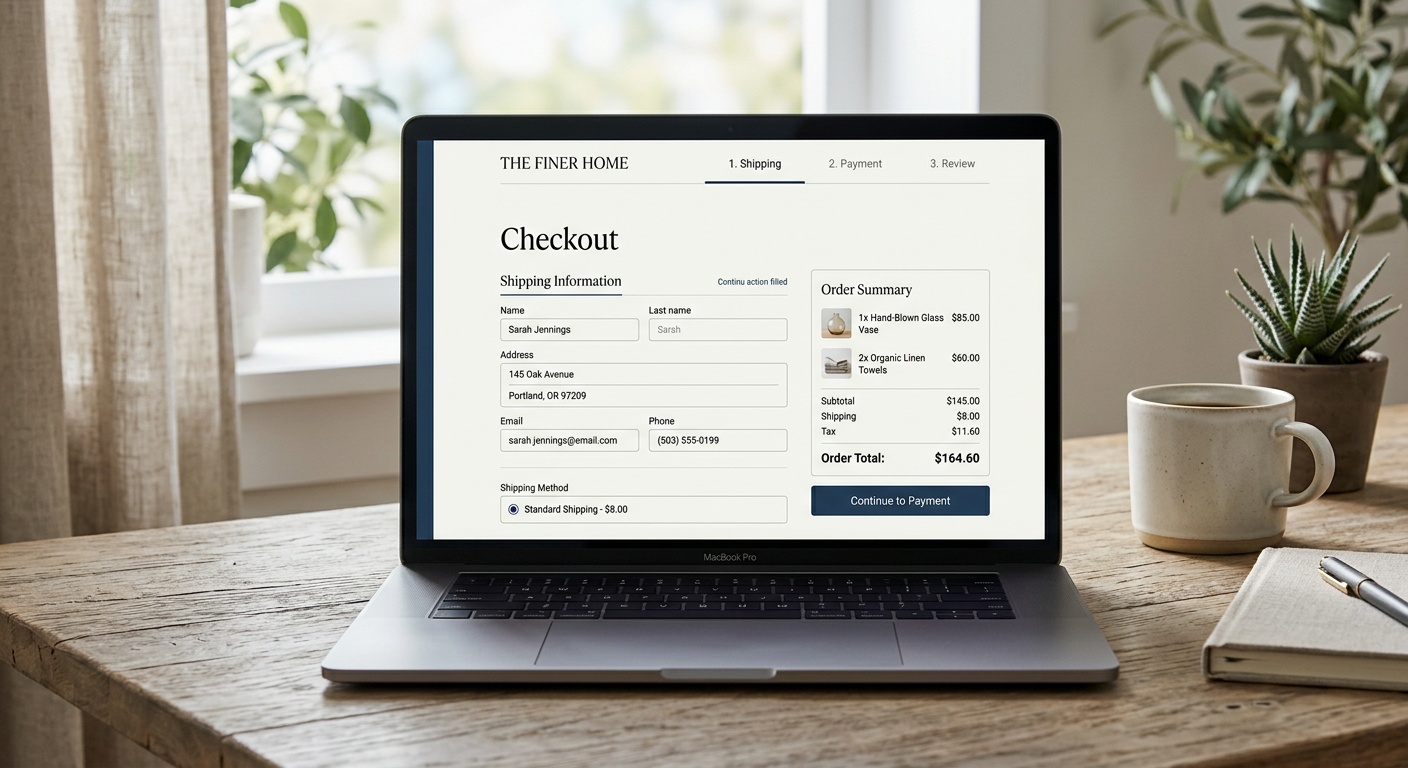
Multi-page checkouts are a relic. In 2026, top-performing stores use single-page or overlay checkouts with biometric authentication (Face ID, fingerprint) and digital wallets like Apple Pay, Google Pay, and increasingly, bank-linked instant pay options. Fewer clicks equal fewer chances to change their mind.
3. Immersive Product Visualization
3D product spins, AR try-ons, and short-form video previews are now standard for fashion, furniture, and beauty categories. Shoppers who interact with 3D or AR content convert at notably higher rates because they feel more confident about fit, size, and color before buying.
4. Micro-Interactions That Build Confidence
Subtle animations—like a cart icon that gently bounces when an item is added, or a progress bar showing “3 items away from free shipping”—reduce anxiety and reinforce that the site is responsive and alive. These small touches feel minor but compound into meaningful trust.
5. Voice and Conversational Search
With voice assistants now embedded in browsers and mobile OS layers, more shoppers search products conversationally (“show me waterproof hiking boots under $100”). Sites optimized for natural-language search see fewer zero-result searches and higher engagement.
Quick Scenario
Imagine a mid-size skincare brand relaunching its site. They add AI-driven product quizzes, AR try-on for lip shades, and one-tap checkout. Within three months, average order value climbs and cart abandonment drops. That’s not luck—that’s design working as intended.
Case Studies: Real Stores, Real Results
Case Study 1 — Home Goods Retailer: A mid-sized home décor brand integrated AR furniture placement in early 2026. Customers could visualize a sofa in their living room via smartphone camera. Result: a 34% increase in add-to-cart rate for AR-enabled products and a noticeable drop in returns, since customers had clearer size expectations.
Case Study 2 — DTC Apparel Brand: This brand replaced its five-step checkout with a single-page, biometric-enabled flow. Checkout completion rose from 61% to 79% within six weeks. Their lead designer noted, “We didn’t redesign our brand—we just removed friction. That was the whole win.”
Case Study 3 — Specialty Food Store: By adding AI-personalized bundles (“customers who bought this also loved…”) powered by real-time browsing behavior, average order value increased by 18%. The catch? It required clean, well-tagged product data first—a reminder that personalization is only as good as your backend.
Common Conversion Killers (And Fixes)
Challenge 1: Slow Mobile Load Times
Over 60% of ecommerce traffic in 2026 comes from mobile, yet many sites still load bloated hero images and unoptimized scripts. Fix: Compress images, lazy-load below-the-fold content, and audit third-party scripts quarterly.
Challenge 2: Hidden Costs at Checkout
Surprise shipping fees remain a top abandonment trigger. Fix: Show estimated totals (including shipping) earlier in the funnel, not just at the final step.
Challenge 3: Overwhelming Navigation
Too many menu categories create decision fatigue. Fix: Simplify top-level navigation to 5-7 categories and rely on smart filters and search for deeper discovery.
Trend Impact Comparison
| Trend | Avg. Conversion Lift | Implementation Effort | Best For |
|---|---|---|---|
| AI Personalization | 15-25% | Medium-High | Mid-to-large catalogs |
| One-Tap Checkout | 18-30% | Medium | All store sizes |
| AR/3D Visualization | 20-34% | High | Fashion, furniture, beauty |
| Micro-Interactions | 5-10% | Low | Any store |
| Voice/Conversational Search | 8-14% | Medium | Large SKU counts |
Visualizing the Lift: Average Conversion Impact by Trend
FAQs
Do I need a full site redesign to see conversion improvements?
No. Most of the gains highlighted above come from targeted upgrades—checkout simplification, image optimization, or adding AR to top-selling categories—rather than a ground-up rebuild. Start with your highest-traffic, highest-drop-off pages.
Is AI personalization worth it for a small store?
It depends on catalog size and traffic volume. If you have under 50 SKUs, simpler tactics like clear navigation and fast checkout will likely deliver better ROI first. Once you scale past a few hundred products, personalization tools start paying for themselves.
How quickly can these changes show results?
Checkout and speed optimizations often show measurable impact within 2-4 weeks. AI personalization and AR features typically need 6-12 weeks to gather enough behavioral data and prove their lift.
Your Roadmap Forward
Ecommerce design in 2026 rewards stores that treat friction as the enemy and trust as the goal. As AI and immersive tech become table stakes rather than differentiators, the brands that win will be the ones that implement thoughtfully—not just quickly.
- Step 1: Audit your checkout flow this week—count the clicks between cart and confirmation.
- Step 2: Pick one high-traffic category and pilot AR or 3D visualization.
- Step 3: Layer in AI personalization starting with your homepage and email recommendations.
- Step 4: Add micro-interactions to reinforce trust at key decision points.
- Step 5: Re-test mobile load speed monthly—it’s the silent conversion killer.
So, where’s your biggest friction point right now? Find it, fix it, and watch what happens to your numbers.